
ITIL is the most widely recognized approach to IT Service Management in the world. We are an authorized reseller of the ITIL network licenses. Please check current prices due to exchange rate fluctuations between the USD and British Pound Sterling.
ITIL Version 3
NEW
ITIL®
2011 Edition
29 July 2011 is the
publication date for the following ITIL 2011 editions:
ITIL's most recent version, Version 3 (V3), represents an important evolutionary step in its life. The refresh has transformed the guidance from providing a great service to being the most innovative and best in class. At the same time, the interface between old and new approaches is seamless so that users do not have to reinvent the wheel when adopting it. V3 allows users to build on the successes of V2 but take IT service management even further.
ITIL Versions: ITIL 2011 Edition is an update, not a new version. The updates to the publications are designed to:
By the time the update is published, ITIL V1 will no longer be in existence and V2 will be actively removed from the market over a period of time, therefore the core publications will be referred to as ITIL. In order to distinguish between the 2007 and the 2011 editions, the latest edition will carry a '2011 Edition' flash.
The ITIL Lifecycle Publication Suite - containing Service Strategy, Service Design, Service Transition, Service Operation, and Continual Service Improvement - offers considerable costs saving against purchasing all five titles individually. This official introduction is your gateway to ITIL. It explains the basic concept of IT service Management and the place of ITIL, introducing the new lifecycle model, which puts into context all the familiar ITIL processes from the earlier books. It also serves to illuminate the background of the new ITIL structure. This title introduces ITSM and ITIL, explains why the service lifecycle approach is best practice in today's ITSM, and makes a persuasive case for change. After showing high level process models, it takes the reader through the main principles that govern the new version: lifecycle stages, governance and decision making, then the principles behind design and deployment, and operation and optimisation.
User Licenses: We are an authorized OGC sales agent for ITIL licenses. Please inquire, let us know how many user licenses you will need. Please inquire about current pricing since the British Pound/US Dollar fluctuates. These prices are current as of July 2009.
Concurrent Network License
This product is 100% online and is accessible by username / password, via an IP range link or via a direct connection to the end user’s intranet. The network license provides unlimited user access but only one at a time per concurrent license.
Prices – ITIL Annual Subscriptions
2 user Concurrent License: $6800.00 ($9130.00 including a matching license for the ITIL ‘Best Practice’ Live product)
3 user Concurrent License: $9720.00 ($13121.00 including a matching license for the ITIL ‘Best Practice’ Live product)
4 user Concurrent License: $12240.00 ($16340.00 including a matching license for the ITIL ‘Best Practice’ Live product)
5 user Concurrent License: $14400 ($19,224.00 including a matching license for the ITIL ‘Best Practice’ Live product)
The ITIL Live product is a new and very beneficial product to any ITIL user whether they new new, intermediate or advanced users of the V3 core text. A description has been provided below:
What is ITIL Live? - “The link between what is written in core publications and what needs to be done in practise”
ITIL Live is a complementary product which works alongside ITIL V3, providing the link between what is written in the ITIL core publications, the ‘What’, and what needs to be done in practice, the ‘How’. ITIL Live is an implementation tool aimed at helping ITIL users gain a better understanding of ITIL V3 enabling theory to be turned into practice. The product has been designed to allow structured progression from one level to another as well as being an efficient source of information for mature users via apps like the toolkit. Already we have a number of consultants, trainers, large and small organisations utilising this brand new product and if this is something that you think will be of benefit, please get in contact with us and I can offer any information you wish including prices and options on this amazing must have ITIL V3 implementation tool.
Books:
NEW
Information Lifecycle Support: Wisdom, Knowledge, Information and Data Management WKIDM
ITIL Planning to Implement Service Management PISM
Management of Value MoV
Service Offerings and Agreements ITIL V3 Intermediate Capability Handbook SOA
Planning, Protection and Optimization ITIL V3 Intermediate Capability Handbook PPO
ITIL V3 Intermediate Capability
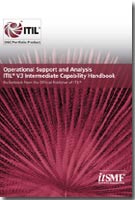
Handbook - Operational Support and Analysis
Authored and quality assured by itSMF UK, this guide provides references to the processes covered by the ITIL V3 Operational Support and Analysis syllabus. Endorsed by the APM Group, It is designed as a revision aid for students taking the ITIL Capability qualification for Operational Support and Analysis, and as a handy portable reference source for practitioners who work with these processes.
Covers the following processes and functions and how they contribute to the Lifecycle:
Operational Support and
Analysis Handbook - Single Copy ISBN: 9780113312085 Price: $20.00
Operational Support and Analysis Handbook
- Pack of 10 ISBN: 9780113312092 Price: $200.00
 Release,
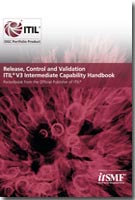
Control and Validation ITIL V3 Intermediate Capability Handbook
Release,
Control and Validation ITIL V3 Intermediate Capability Handbook
Covers the following processes and functions and how they contribute to the Lifecycle:
Release, Control and
Validation Handbook - Single Copy ISBN: 9780113312108 Price:$20.00
Release, Control and Validation Handbook
- Pack of 10 ISBN: 9780113312115 Price: $200.00
 Passing
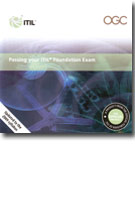
your ITIL® Foundation Exam - 2nd Edition. Study Aid from the Official
Publisher of ITIL. 2009. This publication, 'Passing your ITIL®
Foundation Exam - 2nd Edition' is endorsed by APM Group, the official ITIL
Accreditor, and is suitable for those taking the foundation exam. It has
been updated in line with the new 2009 syllabus. This publication provides
an overview of the purpose, objectives and format of the examination. It
offers a top level introduction to understanding the Service Lifecycle and
each of the five components of the Lifecycle to help candidates pass the
foundation exam and the Version 2 to Version 3 Bridging Exam.
Passing
your ITIL® Foundation Exam - 2nd Edition. Study Aid from the Official
Publisher of ITIL. 2009. This publication, 'Passing your ITIL®
Foundation Exam - 2nd Edition' is endorsed by APM Group, the official ITIL
Accreditor, and is suitable for those taking the foundation exam. It has
been updated in line with the new 2009 syllabus. This publication provides
an overview of the purpose, objectives and format of the examination. It
offers a top level introduction to understanding the Service Lifecycle and
each of the five components of the Lifecycle to help candidates pass the
foundation exam and the Version 2 to Version 3 Bridging Exam.
188 pp. ISBN 9780113312061. paperback. $40.00
 ITIL V3 Guide to
Software Asset Management. July 2009. Appropriate for anyone
involved in the governance, management and use of software assets within an
organisation, this title, 'ITIL V3 Guide to Software Asset Management',
contains a practical approach to the management of software assets. Aligned
with ITIL V3 and ISO/IEC 20000, this book has been developed to assist with
the implementation and maintenance of all the necessary Software Asset
Management (SAM) processes and procedures. It gives realistic and pragmatic
suggestions for the content of a business case for SAM within an
organisation. It provides readers with advice and guidance on the roles
involved, together with templates and examples of some of the key documents.
Including examples of a SAM business case, the contents of a software
policy, a policy on the use of hardware and software, and an acknowledgement
of hardware/software policy. Key features: Updated in line with ITIL V3 and
ISO/IEC 20000; Provides examples and templates of key documentation.
ISBN: 9780113311064. Price: $90.00
ITIL V3 Guide to
Software Asset Management. July 2009. Appropriate for anyone
involved in the governance, management and use of software assets within an
organisation, this title, 'ITIL V3 Guide to Software Asset Management',
contains a practical approach to the management of software assets. Aligned
with ITIL V3 and ISO/IEC 20000, this book has been developed to assist with
the implementation and maintenance of all the necessary Software Asset
Management (SAM) processes and procedures. It gives realistic and pragmatic
suggestions for the content of a business case for SAM within an
organisation. It provides readers with advice and guidance on the roles
involved, together with templates and examples of some of the key documents.
Including examples of a SAM business case, the contents of a software
policy, a policy on the use of hardware and software, and an acknowledgement
of hardware/software policy. Key features: Updated in line with ITIL V3 and
ISO/IEC 20000; Provides examples and templates of key documentation.
ISBN: 9780113311064. Price: $90.00
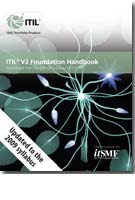
ITIL V3 Foundation Handbook . Pocketbook from the Official Publisher of ITIL (Pack of 10 copies). June 09. Now updated in line with the new 2009 syllabus, this reference revision guide, 'ITIL V3 Foundation Handbook: Pocketbook from the Official Publisher of ITIL' has been designed to help students sitting the ITIL V3 Foundation Exam. The title provides a key reference aid for managers, practitioners, vendors and consultants in the workplace and while travelling. This publication provides an introduction to the ITIL V3 Service Lifecycle model and an overview of the ITIL V3 qualification structure. The guide contains a chapter on each of the components of the Lifecycle; Service Strategy, Service Design, Service Transition, Service Operation and Continual Service Improvement. These chapters contain an overview of each of the process and functions in the lifecycle including value, scope, activities and metrics. Key features: Provides a concise summary of ITIL V3; Follows the 2009 ITIL V3 Foundation syllabus; Contains a glossary of syllabus definitions. ISBN: 9780113311989. Price: $200.00, single copies for $20.00.
 ITIL V3 Small-scale Implementation. August 09.
'ITIL V3 Small-Scale Implementation' has been updated in line with
ITIL Version 3, the Service Lifecycle approach. It provides guidance to
smaller organisations who wish to implement the ITIL guidance or who are
already using it and wish to improve their IT Service Management. The
publication discusses the significance of size, the characteristics of small
organizations and how to scale ITIL down for small organisations. Key
features: A practical guide to scaling ITIL for use in smaller organisations;
Publication structure follows the Lifecycle approach, looking at how each
phase of the lifecycle can be scaled for Small and Medium Businesses; Uses
terminology consistent with the ITIL Service Management Practices and the
ITIL Glossary, acronyms and definitions; Suggest roles and role combinations
suitable for a smaller organisation. ISBN: 9780113310784
Price. $80.00
ITIL V3 Small-scale Implementation. August 09.
'ITIL V3 Small-Scale Implementation' has been updated in line with
ITIL Version 3, the Service Lifecycle approach. It provides guidance to
smaller organisations who wish to implement the ITIL guidance or who are
already using it and wish to improve their IT Service Management. The
publication discusses the significance of size, the characteristics of small
organizations and how to scale ITIL down for small organisations. Key
features: A practical guide to scaling ITIL for use in smaller organisations;
Publication structure follows the Lifecycle approach, looking at how each
phase of the lifecycle can be scaled for Small and Medium Businesses; Uses
terminology consistent with the ITIL Service Management Practices and the
ITIL Glossary, acronyms and definitions; Suggest roles and role combinations
suitable for a smaller organisation. ISBN: 9780113310784
Price. $80.00
ITIL
V3 Guide to Software Asset Management. Colin Rudd. 2009. Appropriate for
anyone involved in the governance, management and use of software assets
within an organisation, this title, 'ITIL V3 Guide to Software Asset
Management', contains a practical approach to the management of software
assets.Aligned with ITIL V3 and ISO/IEC 20000, this book has been developed
to assist with the implementation and maintenance of all the necessary
Software Asset Management (SAM) processes and procedures. It gives realistic
and pragmatic suggestions for the content of a business case for SAM within
an organisation. It provides readers with advice and guidance on the roles
involved, together with templates and examples of some of the key documents.
Including examples of a SAM business case, the contents of a software
policy, a policy on the use of hardware and software, and an acknowledgement
of hardware/software policy. Key features: Updated in line with ITIL V3 and ISO/IEC 20000; Provides examples and templates of key documentation. 146 pp. 9780113311064. $90.00
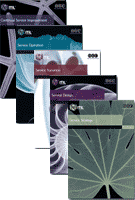 ITIL Lifecycle Publication Suite.
The new core ITIL titles have been commissioned and structure to
be read as a five title series, each building on the work of the other. As
the five core titles reflect the lifecycle of services, their appeal
encompasses the entire spectrum of people involved at any stage of the
framework. So, without being the prime audience, everyone involved will
benefit from access to the entire library.
ITIL Lifecycle Publication Suite.
The new core ITIL titles have been commissioned and structure to
be read as a five title series, each building on the work of the other. As
the five core titles reflect the lifecycle of services, their appeal
encompasses the entire spectrum of people involved at any stage of the
framework. So, without being the prime audience, everyone involved will
benefit from access to the entire library.
Publications in the suite:
The suite of titles offers considerable costs savings against purchasing all five titles individually: save by purchasing all five individually ($935.00).
The new core ITIL titles have been commissioned and structure to be read as a five title series, each building on the work of the other. As the five core titles reflect the lifecycle of services, their appeal encompasses the entire spectrum of people involved at any stage of the framework. So, without being the prime audience, everyone involved will benefit from access to the entire library. The ITIL Lifecycle Publication Suite contain Service Strategy, Service Design, Service Transition, Service Operation, and Continual Service Improvement and offers a considerable costs saving against purchasing all five titles individually.
 The Official Introduction to the ITIL
Service Lifecycle. This official introduction is your gateway to ITIL. It explains the
basic concept of IT service Management and the place of ITIL, introducing
the new lifecycle model, which puts into context all the familiar ITIL
processes from the earlier books. It also serves to illuminate the
background of thr new ITIL structure. This title introduces ITSM and ITIL,
explains why the service lifecycle approach is best practice in today's
ITSM, and makes a persuasive case for change. After showing high level process models, it takes the reader through
the main principles that govern the new version: lifecycle stages,
governance and decision making, then the principles behind design and
deployment, and operation and optimisation.
The Official Introduction to the ITIL
Service Lifecycle. This official introduction is your gateway to ITIL. It explains the
basic concept of IT service Management and the place of ITIL, introducing
the new lifecycle model, which puts into context all the familiar ITIL
processes from the earlier books. It also serves to illuminate the
background of thr new ITIL structure. This title introduces ITSM and ITIL,
explains why the service lifecycle approach is best practice in today's
ITSM, and makes a persuasive case for change. After showing high level process models, it takes the reader through
the main principles that govern the new version: lifecycle stages,
governance and decision making, then the principles behind design and
deployment, and operation and optimisation.
Key features:
A view of ITIL that aligns business and IT so that each brings out the best in the other. It ensures that every element of the Service Lifecycle is focused on customer outcomes and relates to all the companion process elements that follow. Subsequent titles in the core set will link deliverables to meeting the business goals, requirements and service management principles described in this publication.
 Service Strategy.
A view of ITIL that aligns business and IT so that each brings
out the best in the other. It ensures that every element of the
Service Lifecycle is focused on customer outcomes and relates to all
the companion process elements that follow. Subsequent titles in the
core set will link deliverables to meeting the business goals,
requirements and service management principles described in this
publication.
Service Strategy.
A view of ITIL that aligns business and IT so that each brings
out the best in the other. It ensures that every element of the
Service Lifecycle is focused on customer outcomes and relates to all
the companion process elements that follow. Subsequent titles in the
core set will link deliverables to meeting the business goals,
requirements and service management principles described in this
publication.
 Service Design.
In order to meet the current and future business requirements, Service
Design provides guidance on the production and maintenance of IT policies,
architectures, and documents for the design of appropriate and innovative IT
infrastructure service solutions and processes. ITIL Version 3's (V3)
service lifecycle-based practice incorporates the best of V1 and V2 and
tests current best practice for ITSM. For further information visit
www.best-management-practice.com/ITILRefresh. In order to meet the
current and future business requirements, Service Design provides guidance
on the production and maintenance of IT policies, architectures, and
documents for the design of appropriate and innovative IT infrastructure
service solutions and processes.
Service Design.
In order to meet the current and future business requirements, Service
Design provides guidance on the production and maintenance of IT policies,
architectures, and documents for the design of appropriate and innovative IT
infrastructure service solutions and processes. ITIL Version 3's (V3)
service lifecycle-based practice incorporates the best of V1 and V2 and
tests current best practice for ITSM. For further information visit
www.best-management-practice.com/ITILRefresh. In order to meet the
current and future business requirements, Service Design provides guidance
on the production and maintenance of IT policies, architectures, and
documents for the design of appropriate and innovative IT infrastructure
service solutions and processes.
 Service Transition provides guidance and process activities for the
transition of services in the operational business environment. It covers
the broader, long-term change management role, release and deployment
practices, so that risks, benefits, delivery mechanisms and the support of
ongoing operational services are considered. ITIL Version 3's (V3)
service lifecycle-based practice incorporates the best of V1 and V2 and
tests current best practice for ITSM. Service Transition provides
guidance and process activities for the transition of services in the
operational business environment. It covers the broader, long-term change
management role, release and deployment practices, so that risks, benefits,
delivery mechanisms and the support of ongoing operational services are
considered.
Service Transition provides guidance and process activities for the
transition of services in the operational business environment. It covers
the broader, long-term change management role, release and deployment
practices, so that risks, benefits, delivery mechanisms and the support of
ongoing operational services are considered. ITIL Version 3's (V3)
service lifecycle-based practice incorporates the best of V1 and V2 and
tests current best practice for ITSM. Service Transition provides
guidance and process activities for the transition of services in the
operational business environment. It covers the broader, long-term change
management role, release and deployment practices, so that risks, benefits,
delivery mechanisms and the support of ongoing operational services are
considered.
 Service Operation.
ITIL Version 3's (V3) service lifecycle-based practice
incorporates the best of V1 and V2 and tests current best practice for ITSM. Service Operation
introduces, explains and details delivery and control activities to achieve
operational excellence on a day-to-day basis. Readers will find many of the
familiar processes from the former service support and service delivery
books, which have been updated where necessary. Service Operation introduces, explains and details delivery and control
activities to achieve operational excellence on a day-to-day basis. Readers
will find many of the familiar processes from the former service support and
service delivery books, which have been updated where necessary.
Service Operation.
ITIL Version 3's (V3) service lifecycle-based practice
incorporates the best of V1 and V2 and tests current best practice for ITSM. Service Operation
introduces, explains and details delivery and control activities to achieve
operational excellence on a day-to-day basis. Readers will find many of the
familiar processes from the former service support and service delivery
books, which have been updated where necessary. Service Operation introduces, explains and details delivery and control
activities to achieve operational excellence on a day-to-day basis. Readers
will find many of the familiar processes from the former service support and
service delivery books, which have been updated where necessary.
 Continual Service Improvement.
ITIL Version 3's (V3) service lifecycle-based practice
incorporates the best of V1 and V2 and tests current best practice for
ITSM. Alongside the delivery of consistent, repeatable process
activities as part of service quality, ITIL has always emphasised the
importance of continual improvements. Focusing on the process elements
involved in identifying and introducing service management
improvements, this publication also deals with issues surrounding
service retirement. Alongside the delivery of consistent, repeatable process activities as
part of service quality, ITIL has always emphasised the importance of
continual improvements. Focusing on the process elements involved in
identifying and introducing service management improvements, this
publication also deals with issues surrounding service retirement.
Continual Service Improvement.
ITIL Version 3's (V3) service lifecycle-based practice
incorporates the best of V1 and V2 and tests current best practice for
ITSM. Alongside the delivery of consistent, repeatable process
activities as part of service quality, ITIL has always emphasised the
importance of continual improvements. Focusing on the process elements
involved in identifying and introducing service management
improvements, this publication also deals with issues surrounding
service retirement. Alongside the delivery of consistent, repeatable process activities as
part of service quality, ITIL has always emphasised the importance of
continual improvements. Focusing on the process elements involved in
identifying and introducing service management improvements, this
publication also deals with issues surrounding service retirement.
ITIL Small-Scale Implementation 2007 Edition. December 2007. 'ITIL Small-Scale Implementation 2007 Edition' has been updated in line with ITIL Version 3: the Service Lifecycle approach. It provides guidance to smaller organisations who wish to implement the ITIL guidance or who are already using it ands wish to improve their IT Service Management. The publication considers the significance of size, the characteristics of small organisations, and how to scale ITIL down for small organisations. ISBN 0113310781. $80.00
The new Little ITIL® V3. IT Service Management
based on ITIL® V3: A Pocket Guide. This new Pocket Guide is a
concise summary of ITIL® V3, providing a quick and portable reference tool
to ITIL following the major overhaul of the recent Refresh project. A
companion volume to the new bestseller, Foundations of IT Service Management
based on ITIL® V3, this new addition to the VHP range is a guide to the
concepts of ITILV3. It is designed to give managers and practitioners an
overall picture of the ITIL V3 upgrade. The IT Infrastructure Library® (ITIL)
is one of the most widely accepted approaches to IT Service Management in
the world, and has recently been revised to reflect the IT Service Lifecycle
approach to Service Management. ITIL is a best practice framework, drawn
internationally from public and private sector knowledge.. This useful
Pocket Guide covers the basic elements of ITIL V3. An accessible and concise
reference source, it is an invaluable aid for managers and practitioners
within the Service Management industry.
Covering not only the structure of ITIL V3, it also describes the ITIL V3
functions and processes in a separate section, making it a unique and very
practical contribution to the global adoption of ITIL V3. Indispensable for
those using ITIL for the first time or for anyone migrating from V2 to V3,
this Pocket Guide is a key reference source to ITIL V3. ISBN 9789087531027.
$26.40
Older Titles:
 Business
Perspective Volume 2. 2006. Business organisations are
increasingly dependent on the electronic delivery of services,
irrespective of type or size of organisation, and require high
quality information systems (IS) services which can adapt to
business and user requirements as they evolve. This publication,
'Business Perspective Volume 2', contains best practice information
for IT practitioners on the development and delivery of quality IS
services to maximise business objectives and benefits, building on
the foundation of the other publications in the information
technology infrastructure library (ITIL) series. This volume sets
out information on standards and best practice in relation to a
number of key themes including: corporate strategy; IT governance;
change; business continuity; IT asset management; sourcing; and
knowledge management. 162 pp. Printed: ISBN 0113309694. $130.00;
CDROM: ISBN 0113309716. $300.00
Business
Perspective Volume 2. 2006. Business organisations are
increasingly dependent on the electronic delivery of services,
irrespective of type or size of organisation, and require high
quality information systems (IS) services which can adapt to
business and user requirements as they evolve. This publication,
'Business Perspective Volume 2', contains best practice information
for IT practitioners on the development and delivery of quality IS
services to maximise business objectives and benefits, building on
the foundation of the other publications in the information
technology infrastructure library (ITIL) series. This volume sets
out information on standards and best practice in relation to a
number of key themes including: corporate strategy; IT governance;
change; business continuity; IT asset management; sourcing; and
knowledge management. 162 pp. Printed: ISBN 0113309694. $130.00;
CDROM: ISBN 0113309716. $300.00
 Small-Scale Implementation.
Author: Office of Government Commerce (OGC).
Published: 26 Jan 2006. 'Small-Scale
Implementation’ was written for small organisations examining the
quality of their IT service management and either adopting or
considering ITIL®. The guidance in ITIL® is equally as applicable to
small organisations as it is to large multi-nationalcompanies, but
applying it on a small scale is helped by some adaptation and a
pragmatic focus. This publication does not assume the reader is familiar with all
the detail of the core ITIL® books, but has an awareness of the
terms and approaches suggested by ITIL®. Therefore, while everything
in this publication is intended to be useful to those delivering
services in small organisations, much of the content will apply
whatever the size, circumstance, or situation. Sometimes referred to as ‘ITIL® Lite’, this approach is not about
which parts of ITIL® are appropriate, but rather an adapted ITIL®
approach to delivering an improved service, using all aspects of the
guidance tailored to the smaller implementation. This publication addresses the different service management
challenges faced by smaller organisations. Armed with the ideas
presented in this publication, readers will be able to adapt the
ITIL® guidance to deliver benefits in their own, unique, small
implementations. Supersedes IT Infrastructure Library practices in small IT units
(ISBN 0113306741). 102 pp. ISBN 0113309805.
$70.00
Small-Scale Implementation.
Author: Office of Government Commerce (OGC).
Published: 26 Jan 2006. 'Small-Scale
Implementation’ was written for small organisations examining the
quality of their IT service management and either adopting or
considering ITIL®. The guidance in ITIL® is equally as applicable to
small organisations as it is to large multi-nationalcompanies, but
applying it on a small scale is helped by some adaptation and a
pragmatic focus. This publication does not assume the reader is familiar with all
the detail of the core ITIL® books, but has an awareness of the
terms and approaches suggested by ITIL®. Therefore, while everything
in this publication is intended to be useful to those delivering
services in small organisations, much of the content will apply
whatever the size, circumstance, or situation. Sometimes referred to as ‘ITIL® Lite’, this approach is not about
which parts of ITIL® are appropriate, but rather an adapted ITIL®
approach to delivering an improved service, using all aspects of the
guidance tailored to the smaller implementation. This publication addresses the different service management
challenges faced by smaller organisations. Armed with the ideas
presented in this publication, readers will be able to adapt the
ITIL® guidance to deliver benefits in their own, unique, small
implementations. Supersedes IT Infrastructure Library practices in small IT units
(ISBN 0113306741). 102 pp. ISBN 0113309805.
$70.00
 Introduction to ITIL.
Author: Office of Government Commerce (OGC).
Published: 22 Aug 2005. This
is the official introduction to ITIL, the OGC IT Infrastructure Library
from OGC. The complete library is extensive and this unique, official
publication offers an essential overview of the methodology, benefits
and full range of ITIL publications available. Clearly written and practical, anyone learning about ITIL or
championing it within an organisation will find this book invaluable. 242 pages.
paperback. ISBN
0113309732
$70.00; CDROM ISBN 0113309775. $80.00
Introduction to ITIL.
Author: Office of Government Commerce (OGC).
Published: 22 Aug 2005. This
is the official introduction to ITIL, the OGC IT Infrastructure Library
from OGC. The complete library is extensive and this unique, official
publication offers an essential overview of the methodology, benefits
and full range of ITIL publications available. Clearly written and practical, anyone learning about ITIL or
championing it within an organisation will find this book invaluable. 242 pages.
paperback. ISBN
0113309732
$70.00; CDROM ISBN 0113309775. $80.00
Decision Makers Series
 Change: How to Adapt and Transform the Business.
Author: Nigel Nicholson, London Business School. Published: 18 Nov 2004. Adapting
to new, turbulent environments to be ready for the future is one of ht
most crucial managements skills. It is also one of the most difficult,
because change isn't just about plans and schedules - it's about people.
Drawing on modern business examples throughout, Change is a pragmatic
overview of change management for today's decision maker. It outlines
key techniques for the whole change process, from understanding the
catalysts for change to overcome resistance. Chapters include:
Understanding why you need to change; boundaries, goals and plans; people and culture; the importance of communication; generating commitment and overcoming resistance; making changes stick. 96 pages
Change: How to Adapt and Transform the Business.
Author: Nigel Nicholson, London Business School. Published: 18 Nov 2004. Adapting
to new, turbulent environments to be ready for the future is one of ht
most crucial managements skills. It is also one of the most difficult,
because change isn't just about plans and schedules - it's about people.
Drawing on modern business examples throughout, Change is a pragmatic
overview of change management for today's decision maker. It outlines
key techniques for the whole change process, from understanding the
catalysts for change to overcome resistance. Chapters include:
Understanding why you need to change; boundaries, goals and plans; people and culture; the importance of communication; generating commitment and overcoming resistance; making changes stick. 96 pages
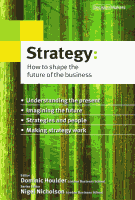 Strategy: How to Shape the Future of Business.
Author: Nigel Nicholson, London Business School.
Published: 18 Nov 2004. Strategic
management is all about the big questions: where you want to be and how
you will get there. Drawing on the very latest research and modern
business examples, Strategy takes a new approach to this complex
subject. It sets out past and present thinking on strategy, providing an
introduction to a range of concepts, tools and techniques to help you
build a brighter business future. Chapters include: what strategy
is and why you need it; understanding the business's strengths,
weaknesses and place in the business environment; looking at a range of
possible business futures; where innovative strategies and new ideas
come from; people and strategy; making strategies work. 96 pages
Strategy: How to Shape the Future of Business.
Author: Nigel Nicholson, London Business School.
Published: 18 Nov 2004. Strategic
management is all about the big questions: where you want to be and how
you will get there. Drawing on the very latest research and modern
business examples, Strategy takes a new approach to this complex
subject. It sets out past and present thinking on strategy, providing an
introduction to a range of concepts, tools and techniques to help you
build a brighter business future. Chapters include: what strategy
is and why you need it; understanding the business's strengths,
weaknesses and place in the business environment; looking at a range of
possible business futures; where innovative strategies and new ideas
come from; people and strategy; making strategies work. 96 pages
 Risk: How to Make Decisions in an Uncertain World.
Author: Nigel Nicholson, London Business School.
Published: 18 Nov 2004. This
book provides a concise overview of how uncertainty can affect your
business, what you can do to manage it, and how it affects decision
making - in theory and in reality. Chapters include: what risk management is and what benefits it can bring; the types if risk a business can face; understanding probability and impact; key techniques for managing risks; the theory and reality of decision making; what to do when things go wrong.
96 pagesISBN1903091365. $18.00
Risk: How to Make Decisions in an Uncertain World.
Author: Nigel Nicholson, London Business School.
Published: 18 Nov 2004. This
book provides a concise overview of how uncertainty can affect your
business, what you can do to manage it, and how it affects decision
making - in theory and in reality. Chapters include: what risk management is and what benefits it can bring; the types if risk a business can face; understanding probability and impact; key techniques for managing risks; the theory and reality of decision making; what to do when things go wrong.
96 pagesISBN1903091365. $18.00
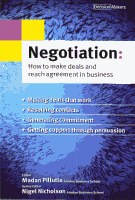 Negotiation: How to Make Deals and Reach Agreement in Business.
Author: Nigel Nicholson, London Business School.
Published: 18 Nov 2004. Wherever
there is something to be lost or gained, there is the potential for
disagreement. To find a constructive way forward when interests and
priorities differ, decision makers need skills in
negotiation.Negotiation outlines crucial techniques for reaching
business agreements in business situations. It will help modern managers
to bring conflicting interests closer, resolve conflicts and generate
commitment. Chapters include: negotiation techniques; making deals and settlements; the reality of win/lose; finding common ground to resolve conflicts; using persuasion to gain support; generating commitment. 96 pages. ISBN 1903091322.
$18.00
Negotiation: How to Make Deals and Reach Agreement in Business.
Author: Nigel Nicholson, London Business School.
Published: 18 Nov 2004. Wherever
there is something to be lost or gained, there is the potential for
disagreement. To find a constructive way forward when interests and
priorities differ, decision makers need skills in
negotiation.Negotiation outlines crucial techniques for reaching
business agreements in business situations. It will help modern managers
to bring conflicting interests closer, resolve conflicts and generate
commitment. Chapters include: negotiation techniques; making deals and settlements; the reality of win/lose; finding common ground to resolve conflicts; using persuasion to gain support; generating commitment. 96 pages. ISBN 1903091322.
$18.00
Buying Software - A Best Practice Approach. Author: Office of Government Commerce. Published: 16 Aug 2004. Based on best practices from the private and public sector, integrating the best project management approaches this title describes the best practice general approach to selecting software and suggests a structured process that will ensure maximum benefit. The guidance is complementary to other OGC Best Practice guidance for other aspects of IT and is just as valuable to smaller software procurements as for large ones. 164 pp. ISBN: 011330918X. $60.00. CD-ROM 0113309414. $60.00
Buying Software - A Best Practice Approach Online Subscription, also contains two extensive evaluation models $560.00
IT governance - a pocket guide based on COBIT. On cover: ITSM Library pocket series. - On title page: ITSM Pocket library. - ITSM = IT Service Management - COBIT = Control Objectives for Information and related Technology. Author: Koen Brand: Harry Boonen. not yet published, 2004. Paperback. 151p. ISBN: 9077212191. $22.00
 Application Management.
OGC. 2002.
Covers software life cycle support, testing of IT services and business
change with emphasis being placed on clear requirement, definition and
implementation of solutions to meet business users' needs. Paperback.
Print: ISBN 0113308663 $130.00
Single User CD-ROM:
ISBN 011330904X $300.00
 The Business Perspective.
2 volumes, November 2004.
The Business Perspective.
2 volumes, November 2004.
OGC.
The Business Perspective:Volume 1 and 2. Business Perspective was originally looking at the delivery of IT from a Business aspect, however it became clear that there was a need to cover two topics; both the business angle and also how IT can successfully work within the wider business environment. As such we have extended the scope of the product and devised two titles which complement each other: The Business Perspective
Volume 1:The IS View in Delivering Services to the Business 0 11
330894 9 $130.00
Volume 2:The Business View on Successful IT
Delivery. 0 11 330969 4 $130.00 due august 2005
Y
ou are also able to buy the 2 Volumes in CDROM: The Business Perspective Set: Volume 1 (available March) and 2 (due summer) CDROM. 0113309023 $480.00 tentative;CDROMs are also sold separately for $300 each.
 ICT Infrastructure Management.
OGC. 2002.
Covers Network Service Management, Operations Management,
Management of Local Processors, Computer Installations and Acceptance, and
for the first time, Systems Management. Paperback.
Print:
ISBN 0113308655 $130.00
Single User CD-ROM:
ISBN 0113309031 $300.00
 Planning to Implement Service Management.
OGC. 2002.
Covers 'Where do I start with ITIL,' and helps organizations identify their
strengths and weaknesses. Paperback.
Print: ISBN 0113308779 $130.00
Single User CD-ROM:
ISBN 0113309058 $300.00
 Security Management.
OGC. 2002.
Covers security from the service provider standpoint and
identifies how security management relates to the IT Security Officer.
Paperback.
Print: ISBN
011330014X $90.00
NEW! CDROM:
ISBN: 0113309422. $120.00
 Service Delivery.
OGC. 2002.
Covers Capacity Management, Financial Management for IT Services,
Availability Management, Service Level Management and IT Continuity
Management. Paperback.
Print:
ISBN 0113300174 $130.00
Single User
CD-ROM:
ISBN 0113308930 $300.00
 Service Support.
OGC. 2002.
Covers Service Desk, Incident Management, Problem Management,
Configuration Management, Change Management and Release Management.
Paperback.
Print:
ISBN 0113300158 $130.00
Single User
CD-ROM:
ISBN 0113308671 $300.00
NEW►Software
Asset Management.
OGC. Sept 2003.
Software is one of the most critical
elements of information and communications technologies and most
organizations have huge investments in software, whether internally
developed or external procured. However organizations often do not invest
commensurate effort into managing these software assets. This guide has been
developed to assist with understanding what Software Asset Management (SAM)
is and to explain what is required to perform it effectively and efficiently
as identified in industry 'best practice.' Key Features: These
guidelines can be tailored to fit any organization, regardless of size •
Illustrated with various charts and tables to aid in understanding • Large
appendices enhancing content within the guide including a Terminology
section • Part of the ITIL series of best practice publications. Paperback,
146 pp.
ISBN 0113309430 $70.00' CDROM ISBN 0113309449 $150.00
ITIL CD-ROM Multi-User Network Licenses: prices are in British pounds and the dollar value is based on current exchange rate.. email Pam for USD price
£150.00 per user per product for one cdrom– Service Delivery, Service Support, Business Perspective Volume 1 and Volume 2, ICT Infrastructure Management, Application Management, Planning to Implement Service Management, Managing Successful Projects with PRINCE2
|
User Bands |
Max. Number of Users |
Cost per User Per title |
Total Cost
|
Total Cost for Individual CD |
Overall Cost Saving |
|
Band 1 1 – 5 Users Band 2 6 – 25 Users Band 3 26 – 100 Users Band 4 101 – 350 Users |
5 25 100 350 |
£150.00 £90.00 £75.00 £60.00 |
£2,250 £7,500 £21,000 |
£3,750 £15,000 £52,500 |
£1,500 £7,500 £31,500 |
for example a 6 user license for Service Support and Service Delivery would be £90.00 X 6 for Service Support and £90.00 X 6 for Service Delivery.
£75.00 per user per product – Security Management, Software Asset Management, Managing Successful Programmes and Management of Risk
|
User Bands |
Max. Number of Users |
Cost per User Per title |
Total Cost
|
Total Cost for Individual CD |
Overall Cost Saving |
|
Band 1 1 – 5 Users Band 2 6 – 25 Users Band 3 26 – 100 Users Band 4 101 – 350 Users |
5 25 100 350 |
£75.00 £45.00 £37.50 £30.00 |
£1,125 £3,750 £10,500 |
£1,875 £7,500 £26,250 |
£750 £3,750 £15,750 |
Back to Home | Company Info | Ordering | Shipping & Tracking | Publishers | Meetings | Search | Site Index | Feedback